Buying Art to Avoid Our Own Voice
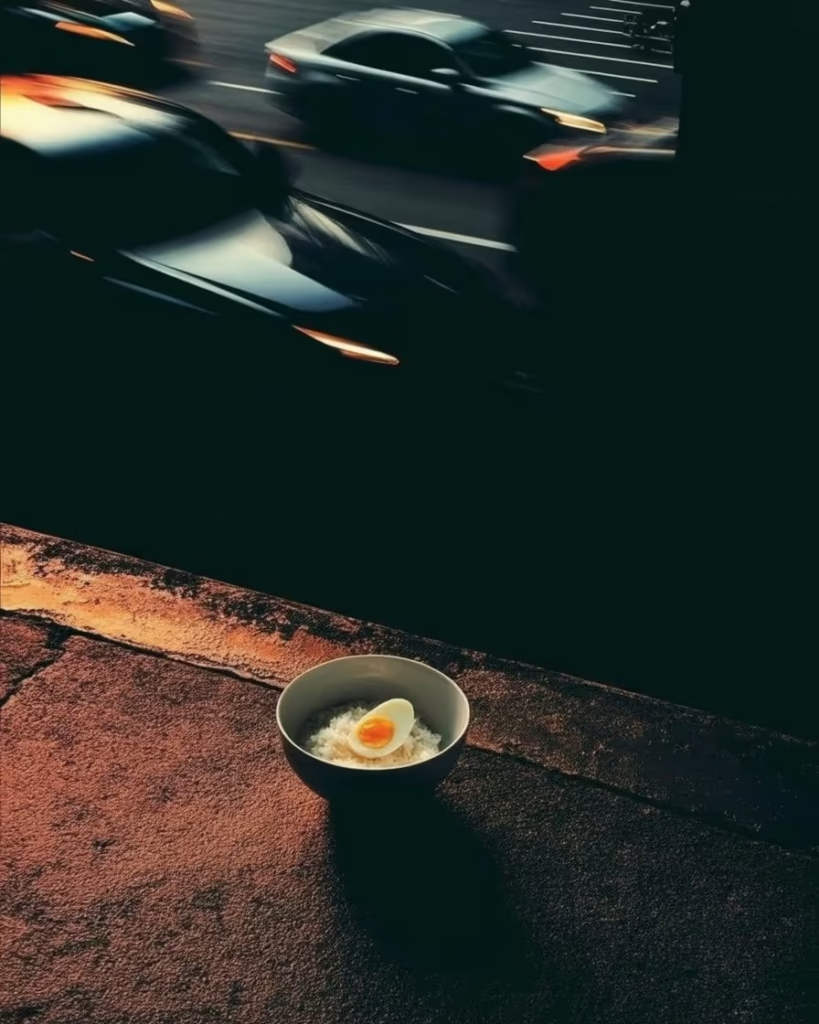
Last month I spent eight hundred taka on a small ceramic bowl. Not because we needed another bowl—Happy raised her eyebrow in that way that means “we already have bowls”—but because something about its imperfect glaze reminded me of monsoon mornings. The potter probably spent hours shaping it, firing it, watching it transform in ways beyond his control. I bought it in thirty seconds.
This morning I stared at a blank page for an hour, then closed my notebook without writing a single word.
There’s something perverse about how easily we’ll pay for other people’s creative risks while hoarding our own. I’ll spend my lunch money on a book of poems by someone brave enough to embarrass themselves with feelings, then convince myself I have nothing worth saying. I’ll buy paintings that speak to experiences I’ve had but never documented, never examined, never offered to the world.
Money, it seems, is easier to part with than dignity.
When I handed over those eight hundred taka, I was purchasing more than a bowl. I was buying the potter’s willingness to fail, his courage to transform raw clay into something that might matter to a stranger. I was paying for his audacity to believe that his particular way of seeing deserved to exist in the world. What I couldn’t buy was his conviction that creation was worth the risk.
Happy keeps asking why I don’t write anymore—not the practical writing that pays our bills, but the other kind, the kind that might reveal who I actually am. I tell her I don’t have time, but that’s a lie wrapped in a truth. The real answer is more complicated: I don’t write because writing would require me to believe that my inner world is worth documenting, and that belief feels like a luxury we can’t afford.
This is the economics of creativity: we pay others to do what we’re too afraid to attempt ourselves. It’s safer to be consumers in the marketplace of human expression. Consumers get to maintain their mystery, their protection from judgment. Creators have to stand naked in the town square of public opinion, holding up their attempts at meaning and asking, “Is this worth anything to you?”
I think about the artists whose work lines our walls—photographs bought from street vendors, small sculptures from local craftsmen, books by writers who had the audacity to finish their thoughts. Each purchase was an act of gratitude, but also an act of surrender. I was acknowledging their courage while simultaneously declaring my own inadequacy.
But here’s what I’m beginning to understand: every purchase of art is also a purchase of our own silence. We pay others to speak for us, to feel for us, to imagine for us. We become spiritual consumers, outsourcing our own attempts at making sense of existence to people we’ll never meet.
The ceramic bowl sits on our table now, holding the small oranges Arash peels for his afternoon snack. It has become part of our daily life, integrated into the ordinary rhythms of existence. This is what I paid for—not just the object, but the potter’s vision becoming part of our vision, his aesthetic choice shaping our daily experience.
Yet I wonder what would happen if I stopped buying other people’s courage and started investing in my own. What if, instead of spending money on books, I spent time writing? What if, instead of collecting other people’s attempts to understand life, I attempted my own understanding?
The answer frightens me because it requires believing that my particular confusion, my specific way of being lost, might offer something valuable to other confused, lost people. It requires the kind of arrogance that says: my dreams matter, my observations deserve preservation, my attempts at beauty are worth the risk of failure.
Money is finite, but dignity—once lost—feels irretrievable. When I buy art, I’m purchasing other people’s willingness to risk their dignity for the sake of creation. When I avoid creating, I’m protecting mine at the cost of never knowing what I might have contributed to the world.
There’s a notebook in our bedroom drawer filled with half-finished poems from my university days. Sometimes I open it and read the fragments—incomplete thoughts, broken metaphors, failed attempts at capturing something true. They embarrass me now, but they also remind me of a time when I believed my voice mattered enough to attempt its preservation.
What changed? When did I decide that consumption was safer than creation? When did I convince myself that paying for other people’s courage was more economical than finding my own?
I think about Arash, who draws constantly without questioning whether his art is “good enough” to exist. He doesn’t separate creation from living—he makes things because making things is part of how he processes the world. When did I learn to separate these activities? When did creating become something other people do while I pay to watch?
The ceramic bowl holds oranges, but it also holds a question: what would I create if I stopped spending my creative energy on consuming other people’s creations? What voice would emerge if I stopped filling my ears with other voices?
Perhaps the economics of creativity aren’t about money at all. Perhaps they’re about faith—faith that our particular way of seeing deserves to exist, faith that our attempts at beauty matter, faith that the world needs our version of truth alongside all the others.
The potter who made our bowl probably never expected it to travel to Dhaka, to hold the oranges my son peels while thinking his eleven-year-old thoughts. But he made it anyway, trusting that someone, somewhere, would recognize something valuable in his work.
What am I not making because I can’t trust that someone, somewhere, might find value in my attempts at meaning?
Tonight I’m going to open that notebook again. Not to buy someone else’s courage, but to remember my own.