
Cathedral
Sad people don’t cook to eat. They cook to not think.
Nobody tells you this. The stages of depression come with a long list of symptoms — feeling empty, feeling numb, feeling exhausted. Nobody mentions the fourteen onions at 2 AM.
The Onions Went In at 2 AM
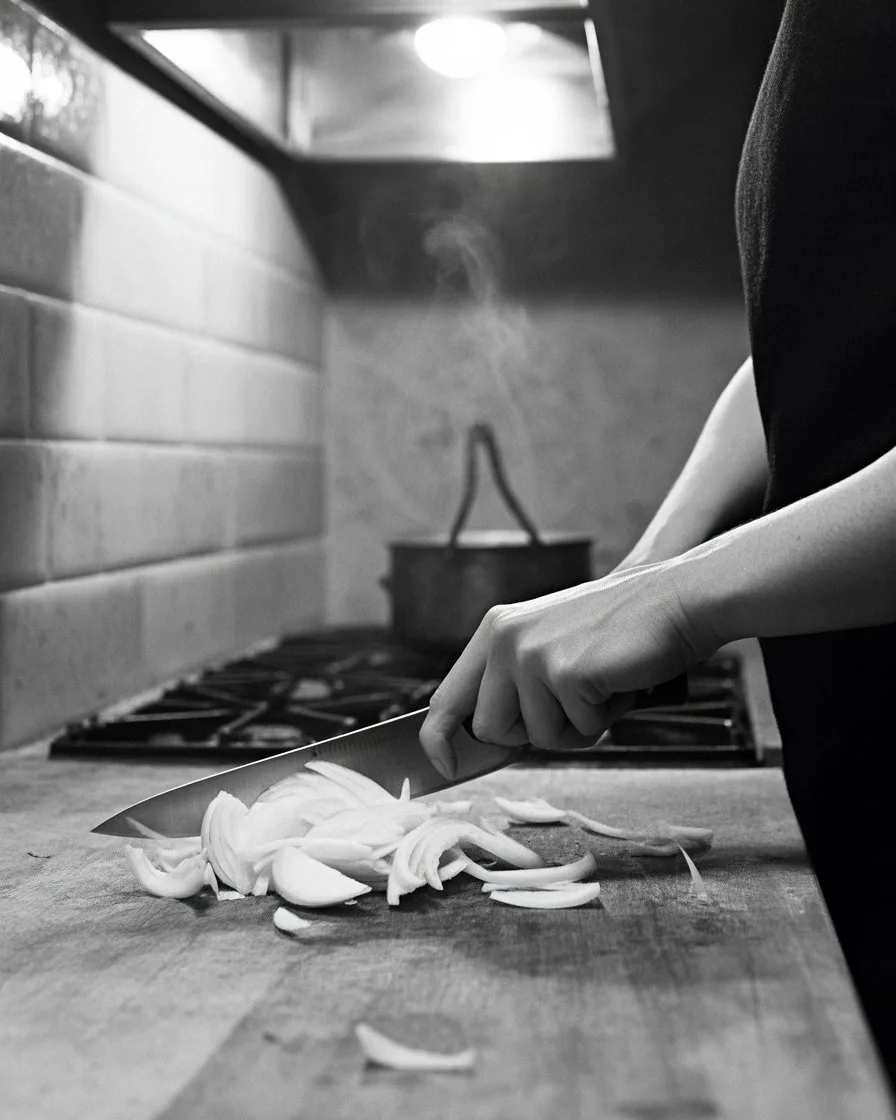
Not because of hunger. Not because anyone asked. The knife came out, the cutting board, the oil. Hands moved before the brain decided anything. Fourteen onions. Each one split, then quartered, then sliced thin as paper. Eyes burning. Let them burn. That’s the point.
Someone found me like that. Standing at the stove in yesterday’s clothes.
“Why such complicated cooking?”
No answer. There was nothing to say that the onions weren’t already saying.
When Things Are Fine, Food Is Just Food
Good days are careless. A pinch of this. Whatever amount of that. The hand waves over the pot like it doesn’t matter, because it doesn’t.
But when something breaks inside — a relationship, a phone call, a Tuesday — suddenly there are fourteen onions. Suddenly there is a recipe that requires overnight marinating. Suddenly there is bread that needs four hours of proofing and you are watching it, actually watching it, like it might leave if you look away.
The broken cook measures everything twice.
The fine cook doesn’t measure at all.
Feeling Nothing Has a Smell
Depression eating is not what people think. It is not bingeing on the couch. It is not forgetting to eat for three days. Sometimes it is standing at the stove at midnight making something so complicated that the mind has no room left for the grief.
The biryani I make when I’m fine is fine. The biryani I make at 2 AM after a bad day has something in it that I cannot put back in on a good afternoon. Some layer. Some depth. Same recipe, same measurements. It comes out flat.
Pain is a spice with no name on the jar.
The Kitchen Has Rules. The Rest of Life Does Not.
Outside the kitchen, things end without warning. People leave without explanation. Bodies fail without asking permission.
But in the kitchen, onions caramelize at medium heat. Always. Every time. Dough rises when the conditions are right and the time is enough. The rules don’t change because you’re having a hard month. The rules don’t care.
Apply heat, get result. Follow process, get outcome.
This is the closest thing to fairness I’ve found.
People talk about the stages of depression like there is a clean path through — one door closes, another opens, you come out the other side changed. The kitchen knows better. There is no other side. There is just the next hour. And the hour after that. And whether or not the bread burned.
Around 3 AM, Someone Came Back
Sat at the kitchen table without being asked. Didn’t say anything for a long time.
Then: “Is it almost done?”
“Two more hours.”
A nod. Head down on folded arms. Asleep at the table while the biryani cooked. I watched and stirred the pot.
This is what depression grief looks like from the inside. Not dramatic. Not loud. Just a person standing at a stove, and another person sleeping at a table, and something slow-cooking between them that neither one can name.
Feeling Isolated Ends When the Food Is Done
The stove turned off. Eyes opened. Hair pressed flat on one side.
“Done?”
“Done.”
One bite standing at the counter. Then another.
“Why does it always taste like this when you make it like this?”
No way to explain it without explaining everything. So just the bowl, passed over.
The Elaborate Cooking Fades
One week it’s croissants at midnight — folding butter into dough thirty-two times because the recipe says thirty-two and nothing is getting shortcut right now, not one single thing. The next week it’s toast over the sink and that’s enough.
Something shifted. Not fixed. Just shifted.
The desperate need — that specific need to fill every hour with something that requires everything — goes quiet. The mind becomes a safer place to stand. Toast tastes like something again.
This is one of the stages of depression nobody puts on the list: the stage where you stop needing to build cathedrals just to get through the night.
Feeling Hopeless Asks a Simple Question
Once, a voice asked: “Do you feel better after?”
Thought about it.
Never better. Not exactly. Finished. Like the day has an ending now. A thing was made. The thing exists. It can be eaten. There is something on the other side of the hours that wasn’t there before.
That’s not better. But it’s not nothing.
Something Came Apart. Something Was Put Together.
Maybe this is what’s really happening at 2 AM with the onions: proving something that can’t be proved any other way. These ingredients were separate. Now they are one thing.
The math doesn’t work. The biryani doesn’t fix what’s broken. But the hands needed to transform something, and the kitchen was there, and the onions were there, and now there is a pot of something that smells like it took all night — because it did.
The empty bowl went in the sink.
“Come to bed.”
“In a minute.”
The last burner off. The kitchen went quiet the way it goes quiet at 4 AM — total, specific, like a held breath.
The pot sat there. Still warm.
I don’t know what I was waiting for. Maybe nothing. Maybe just one more minute in the place where the hours went, before going back to the rest of it.
Then the light went off.



Leave a thought