
From Consuming to Making: Permission to Begin Now
The woman in Jamiul’s painting wasn’t hanging clothes. I see that now, three months later, as I lie sleepless at 3 AM with rain drumming against our window. She was performing a ritual of transformation—taking the weight of the day from her family’s bodies and offering it to the wind. But I couldn’t have articulated this when I first encountered her, frozen mid-gesture on that small canvas, her spine curved like a question mark against the painted sky.
Why do we hunger so desperately for what we’ll never attempt to create?
I’ve been carrying this painting in my mind like a wound that won’t heal. Not because it’s beautiful—though it is—but because it revealed something grotesque about how I move through the world. I am a collector of other people’s courage. I harvest their willingness to fail, to expose themselves, to translate the untranslatable. I fill my shelves with their risks while keeping my own hands safely empty.
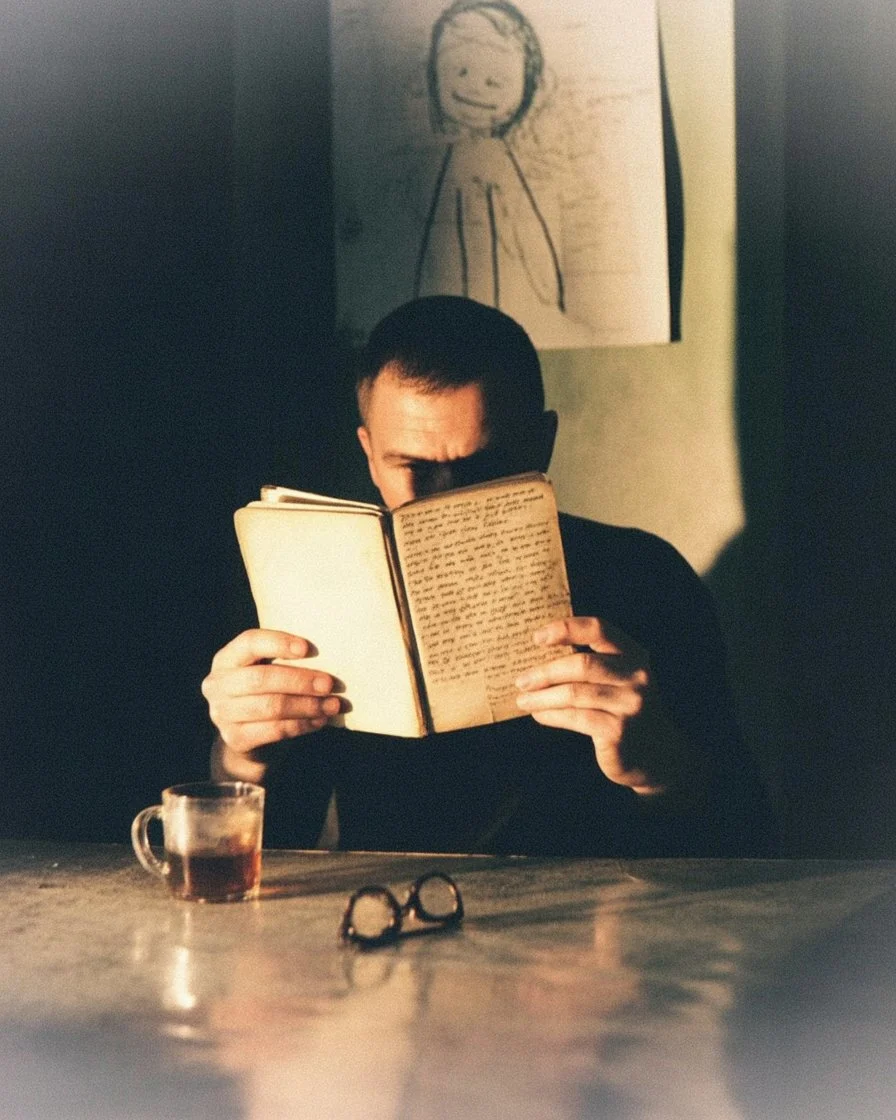
Last week, Arash found an old notebook of mine from university—pages of half-finished poems, fragments of stories that died mid-sentence. “Baba, why did you stop?” he asked, tracing his finger over faded ink. The question hit like a diagnosis. When had I decided that creation was for them and consumption was for me? When had I relegated myself to the audience, as if my own vision were somehow less worthy of existence?
The answer came to me while watching Happy arrange flowers she’d rescued from the market’s closing hour—wilted jasmine and dying roses that she somehow coaxed back to beauty. She creates constantly: meals from nothing, peace from chaos, hope from our daily defeats. She transforms the raw material of living into something bearable, even beautiful. But she would never call herself an artist.
We live in a world that has convinced us creation belongs to the chosen few, that galleries and publishers and concert halls are the only places where human expression matters. We’ve forgotten that the first artist was probably someone like Happy—someone who looked at their small world and decided to make it less brutal, more true.
But here’s the deeper violence we commit against ourselves: we don’t just avoid creating—we’ve taught ourselves not to see our lives as worthy of translation. The way Happy’s hands move when she’s worried, the specific quality of light that floods our balcony at 6 PM, the sound Arash makes when he’s thinking hard—these moments are rich with meaning, heavy with the weight of being human. Yet I let them pass unmarked, unwitnessed, unrecorded.
I think of my mother’s final weeks, how she would stare at the ceiling and move her lips without sound. I thought she was praying, but now I wonder if she was composing—finally attempting to organize her life into something comprehensible, something that could be passed on. What died with her that could have lived in words, in images, in melodies? What music did we bury because no one believed her inner world deserved documentation?
The woman hanging clothes knew something I’m only beginning to understand. She wasn’t performing housework; she was practicing resurrection. Each piece of fabric she lifted carried the day’s weight—sweat and worry and small defeats. By evening, they would be clean, transformed, ready to hold another day’s experiences. This is what all creation does: it takes the raw ore of living and refines it into something that can be shared, examined, treasured.
I collect art because I recognize my life in it, but by never creating, I deny others the chance to recognize theirs in me. I hoard other people’s attempts to make sense of existence while refusing to contribute my own translation of what it means to be briefly alive, briefly aware, briefly capable of love and loss and the terrible beauty of trying to continue.
The cruelest irony is that we already create constantly—we just don’t recognize it as art. Every conversation that changes someone’s perspective, every gesture of comfort, every decision to continue despite uncertainty is an act of creation. We sculpt meaning from chaos daily, yet we’ve convinced ourselves this doesn’t count because it doesn’t fit in frames or appear in books.
Tonight, as rain reshapes the darkness outside our window, I’m beginning to understand that the question isn’t why we collect art but rarely create it. The question is why we’ve forgotten that living consciously is itself an act of creation, and that our obligation isn’t to produce masterpieces but to bear witness to the masterpiece of being human—even when, especially when, it’s ordinary and imperfect and ours.
The woman in Jamiul’s painting will hang clothes forever, suspended in her moment of transformation. But I don’t have to remain suspended. I can pick up the pen, the brush, the camera—not because I’m qualified, but because I’m here, and being here is qualification enough.
What we call art is simply life that someone cared enough to preserve. The tragedy isn’t that we’re not all artists. The tragedy is that we’ve forgotten we already are.

Leave a thought