
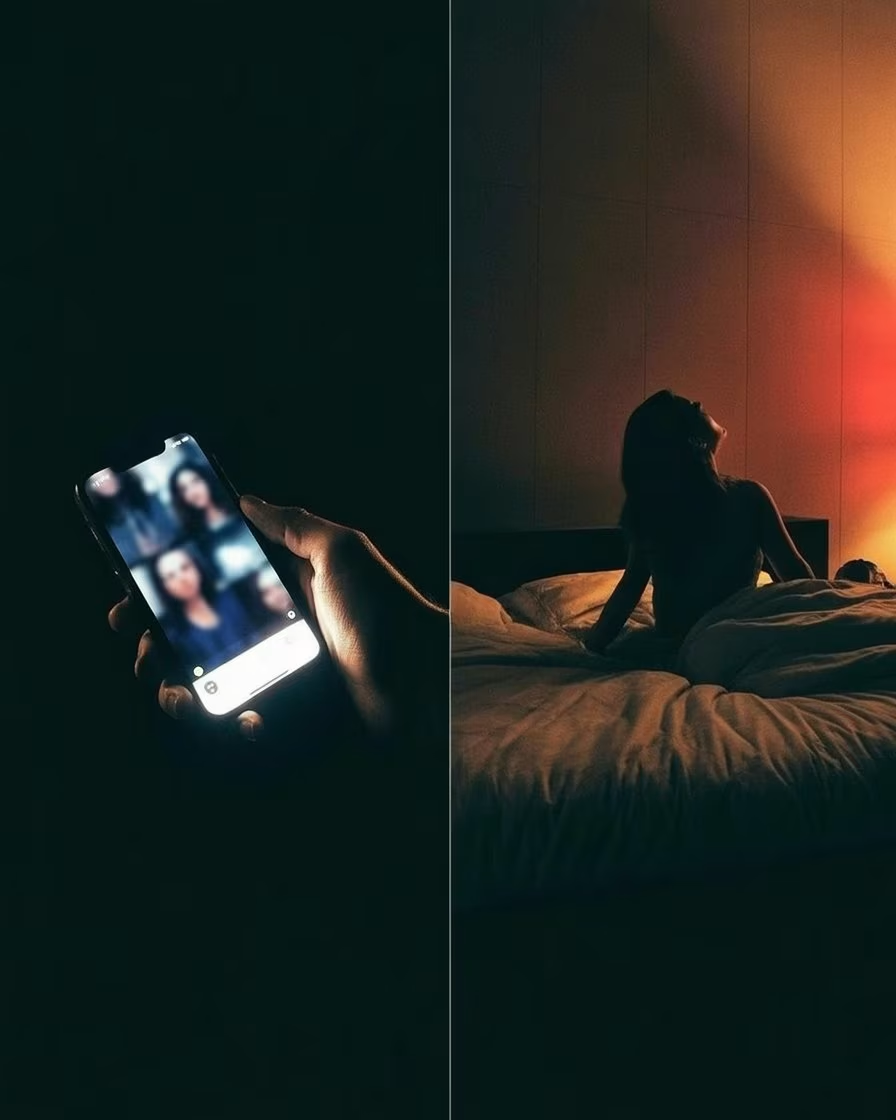
I was watching Happy read last Tuesday evening, her face lit by the warm glow of her phone screen, when something shifted in my perception like a camera finding its focus. For thirty-nine years, I had been studying other people’s faces, searching for something I couldn’t name. In that moment, I realized what I’d been looking for: myself.
Not the reflection you see in mirrors—that surface stranger who never quite matches the person you feel yourself to be. I’d been searching for the deeper self, the one that exists behind your own eyes, the consciousness that watches your thoughts and wonders who’s doing the watching. I’d been hoping to catch a glimpse of that essential self reflected in someone else’s experience, as if external validation could confirm my own existence.
The recognition was both liberating and devastating.
I thought about every time I’d felt disappointed when someone didn’t react to a story the way I expected, every time I’d felt unseen when my emotions weren’t mirrored back to me, every time I’d felt lonely in a crowd because no one seemed to be having the same internal experience I was having. I had been treating other people like mirrors, and when they failed to reflect me back to myself, I’d assumed the problem was with the mirror.
But people aren’t mirrors. They’re windows.
This morning, Arash came to me with a drawing he’d made—abstract swirls of color that he announced was “the feeling of being happy.” I looked at the bright yellows and energetic reds and found myself thinking it looked nothing like my own experience of happiness, which tends toward quieter blues and gentle greens. My first instinct was to correct him, to explain what happiness “really” looks like.
Then I caught myself. Why was I assuming his happiness should resemble mine? Why was I expecting his internal landscape to validate my own?
This is the trap we fall into: we meet each new person hoping they’ll be the one who finally sees us clearly, who recognizes us completely, who confirms that our way of experiencing the world is the right way. We’re all walking around with invisible signs that read “Please tell me I exist” and feeling disappointed when people respond to their own signs instead of ours.
I remember the first time I met Happy’s friend Zara. She spoke about books with such passion that I found myself nodding along, agreeing with her interpretations even when they contradicted my own understanding. I wasn’t responding to her insights—I was hoping she would validate mine. When she didn’t mention the themes that had moved me most, I felt strangely rejected, as if her different reading experience somehow negated my own.
It took me years to understand that Zara wasn’t supposed to be a mirror reflecting my thoughts back to me. She was supposed to be herself, and her different perspective was a gift, not a judgment. But I was so busy looking for myself in her that I missed the opportunity to actually see her.
This pattern followed me everywhere. In conversations, I would listen not to underst and others but to find points of connection that confirmed my own experiences. I would share stories not to communicate but to elicit responses that would make me feel recognized. I was using relationships as a kind of existential sonar, bouncing my sense of self off other people and listening for the echo that would tell me where I stood.
The cruel irony is that the harder you look for yourself in others, the less likely you are to find either yourself or them. It’s like trying to see your own face by looking at other people’s faces—you end up seeing neither clearly.
I think about my relationship with my brother. For decades, we’ve maintained a polite distance that I always attributed to our different personalities. But sitting here now, I realize I spent our childhood expecting him to be a version of me, to share my interests, to validate my choices through his approval. When he developed his own distinct way of moving through the world, I felt it as a kind of betrayal rather than the natural unfolding of a separate human being.
We’re still working through that dynamic. Last month, he called to tell me about a promotion at work, and my first thought was how different his definition of success was from mine. My second thought was why that should matter. His achievements don’t diminish mine; his values don’t invalidate mine; his way of being in the world doesn’t negate my own.
But this realization brings its own challenges. If I stop looking for myself in others, what do I look for instead? How do we connect across the fundamental isolation of individual consciousness?
The answer, I’m learning, is to look for others in others. To approach each person as a complete universe rather than a potential reflection. To listen to their stories not for echoes of my own but for the unique music of their particular existence.
When Happy tells me about her day, I’m learning to hear it as her day, not as a variation of how I might have experienced the same events. When Arash shares his thoughts about friendship or school or the way clouds move, I’m trying to receive them as glimpses into his specific way of being eleven years old, not as confirmation or contradiction of my own memories of childhood.
This shift requires a different kind of courage. When you’re looking for yourself in others, rejection feels personal but connection feels validating. When you’re genuinely trying to see others as they are, you have to accept that they might be fundamentally different from you in ways that challenge your understanding of how humans work.
But the reward is real connection instead of projected connection. Real friendship instead of mutual narcissism. Real love instead of sophisticated self-love dressed up as intimacy.
I watch Happy reading, and instead of wondering whether she’s experiencing the story the same way I would, I find myself curious about her actual experience. What draws her to this particular book? How does her mind process narrative differently from mine? What does she see that I miss? What does she miss that I see?
These questions don’t threaten my sense of self the way they used to. They expand it. By truly seeing Happy as herself rather than as a reflection of me, I paradoxically feel more real, more solid in my own existence. I don’t need her to mirror me back to myself because I’m no longer afraid that without external validation, I might disappear.
This is the strange mathematics of human connection: the more clearly you see others as separate from yourself, the more clearly you see yourself. The more you stop demanding that people reflect you, the more genuinely reflective you become. The moment you stop looking for yourself in everyone else is the moment you finally find yourself exactly where you’ve always been—behind your own eyes, having your own irreplaceable experience of being alive.
Tonight, when Arash shows me his homework or Happy shares something funny that happened at the market, I’ll practice this new way of seeing. I’ll look for them in them, not for me in them. I’ll listen to their experiences as windows into their worlds, not as mirrors of my own.
And maybe, in seeing them clearly for who they are rather than who I need them to be, I’ll finally glimpse who I am when I’m not looking for myself in all the wrong places.


Leave a thought