
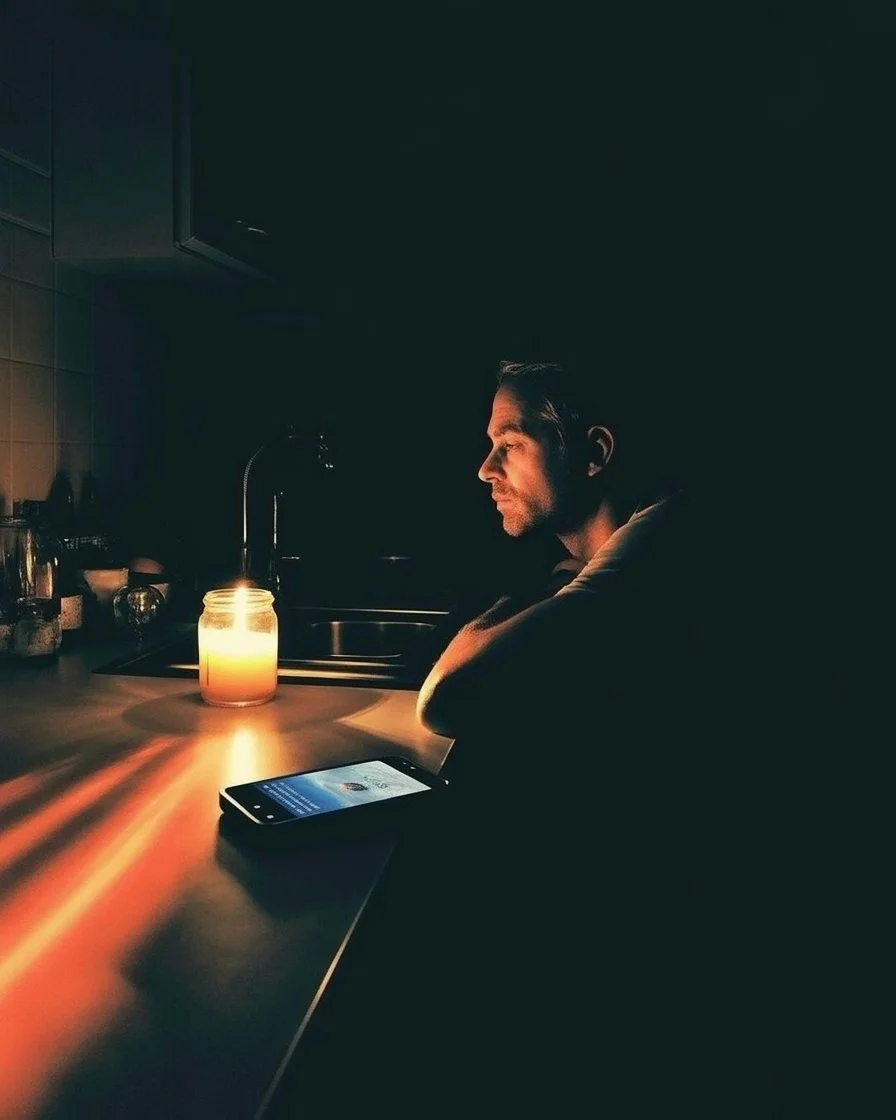
It was 2 AM and my face was blue from the screen, the distinct exhaustion of digital burnout setting in.
My wife came out of the bedroom. She didn’t say anything at first. She looked at me, then at the phone in my hand, then back at me. Like she was making sure she had the sequence right.
“What are you looking at?”
“Pictures.”
“Of what?”
I looked down at the screen. A woman standing on a beach somewhere. Turquoise water. She was smiling at whoever was holding the camera. I didn’t know her.
“I don’t know.”
My wife sat down next to me on the couch. She didn’t take the phone away. She didn’t say anything else. We sat there for a while, the blue light moving across both our faces.
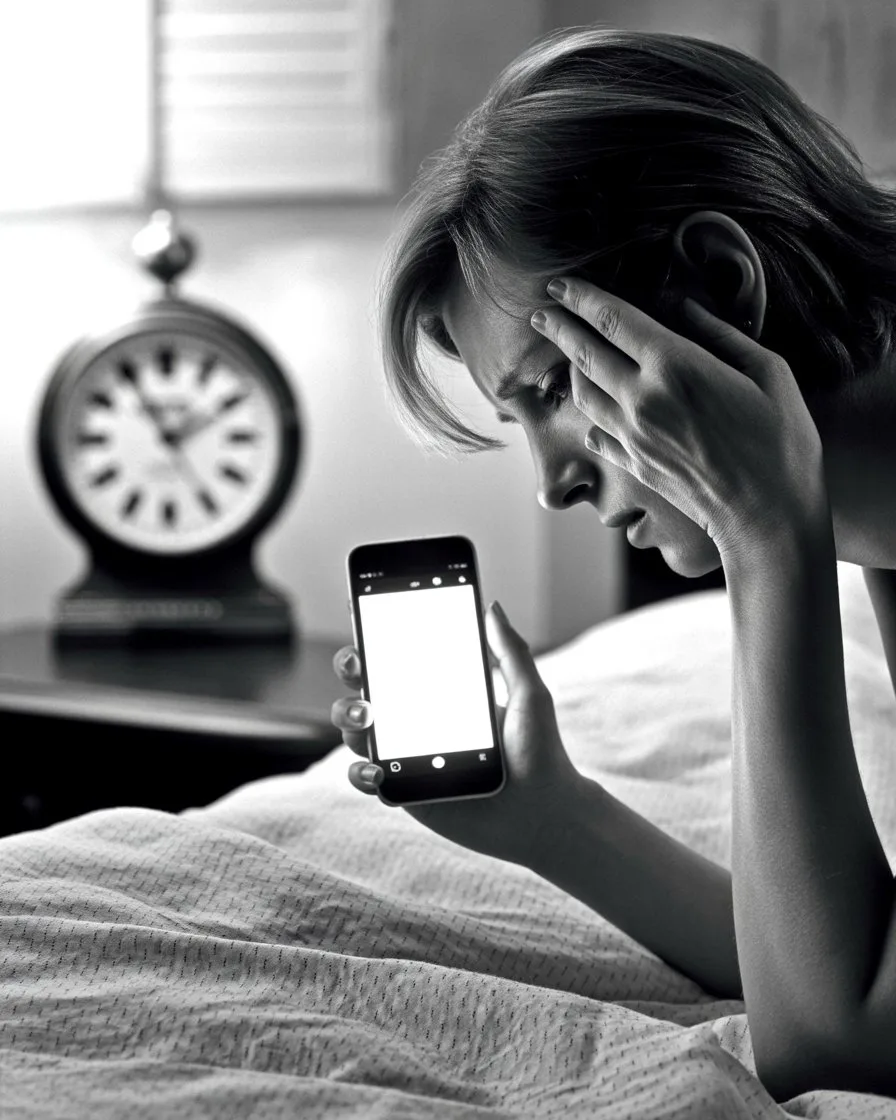
“You do this every night now,” she said finally. “Like a phone addiction.”
“I know.”
“What are you looking for?”
I put the phone face-down on the cushion. The room went dark. Outside, a dog was barking somewhere three or four streets over, then stopped.
“I don’t know that either,” I said.
When I was a kid we had one phone. It was attached to the wall in the kitchen. Green, with a long coiled cord that could stretch almost to the dining room table if you pulled it right. When my friends wanted to talk to me they called that number and whoever answered it would call my name up the stairs.
There was no other way to reach me. There was no constant connectivity.
I used to spend entire Saturday afternoons waiting. Not for anything specific. Just in the day, inside it, the way you’re inside weather. I’d lie on the floor of my room with the radio on and not read the book that was open on my chest. The afternoon would just pass. I didn’t think about it passing.
I told my wife about this once. We were in the kitchen, cooking. She laughed.
“We used to drive to each other’s houses,” she said. “Without calling first. Just show up.”
“And if nobody was home—”
“You drove back.” She was cutting onions, not looking up. “That was it. You just drove back. It was a kind of slow living we didn’t even notice.”
“Did that bother you?”
“I never thought about it.” She scraped the onions into the pan. “It was just how things worked.”
We stood there listening to them sizzle.
“The video store,” I said.
“Friday nights.”
“Twenty minutes choosing.”
“Because you could only rent two.” She smiled at the pan. “And you had to live with whatever you picked.”
Our son is nine. He was born into this. He doesn’t know what it means to not know something, to live without screen time limits on his curiosity. Every question he has, every argument at the dinner table, every “what’s the biggest,” “what’s the fastest,” “which is heavier” — he already knows the answer is somewhere, findable in under ten seconds, and the not-knowing is only ever a temporary state.
He asked me once what we did when we didn’t know things.
“We asked someone,” I said. “Or we looked it up in a book. Or we just didn’t know.”
He thought about that. “What did that feel like?”
I tried to remember. “Normal,” I said. “It just felt normal.”
He looked at me the way he sometimes looks at photographs of people who are dead.
One night at dinner I reached for my phone while he was talking.
It was automatic. He was telling me something about school — a fight between two kids, someone cried, the details were complicated — and my hand just went to my pocket. The phone was already in my palm before I’d decided to pick it up.
He stopped talking.
I put it back down.
“Sorry,” I said. “Keep going.”
He looked at me for a moment. “You do that a lot.”
“I know.”
“Why?”
The pan was still on the stove. I could hear it ticking as it cooled.
“I don’t know,” I said. “I’m trying to stop. I’m trying to figure out how to stop checking phone constantly.”
“But why do you do it? Like, what are you looking for?”
He said it the same way my wife had, that night at 2 AM. I’d had weeks to think of an answer and I still didn’t have one.
“It’s like…” I tried. “You know when you open the fridge and you’re not hungry, you just open it and look?”
He nodded.
“It’s like that.”
He considered this seriously. Then: “But what if there’s nothing in the fridge?”
“You close it,” I said. “And you’re still not hungry. You just—” I stopped.
He was nodding slowly, as if I’d explained something.
A month ago, a Tuesday, I left my phone in the car.
Not on purpose. I got to work and realized it was in the cupholder and thought, I’ll get it at lunch, and then I didn’t get it at lunch, and by the time I was walking to the parking lot at the end of the day I’d been without it for nine hours.
The first hour had been actual discomfort. I kept reaching. The phantom shape of it in my pocket, which wasn’t there—an involuntary dopamine detox. I stood at the coffee machine and had nothing to look at. I ate lunch with both hands on the table.
By the afternoon something had changed. I sat through a meeting and watched people’s faces. I noticed things with a strange mental clarity. The way the light changed in the room as clouds moved outside. The way one of my colleagues tapped his pen against his knee when he was thinking. I’d worked with him for three years and I’d never noticed that before.
Walking to the car that evening, I felt something I didn’t immediately have a name for. It was the feeling of simply being present. The air was cold. A man was walking a dog on the other side of the street. A kid rode a bicycle past me too fast and turned at the corner and was gone.
I stood next to my car for a moment before getting in.
Then I got in, found the phone in the cupholder, and turned it on. Forty-one notifications. I worked through them in the parking lot for twelve minutes.
I thought about that kid on the bicycle. I couldn’t remember what color it was.
Sometimes I think about my father.
He used to sit on the back step in the evenings after dinner. Just sit there. No book, no radio, no task. The yard, the fence, the light changing. I’d ask him what he was doing and he’d say, just sitting. Pure quiet reflection. I thought that was strange — that you would choose to do just one thing, and that one thing would be nothing.
I understand it better now but I understand it from a distance, the way you can understand a language you’ve stopped speaking.
He’s been gone six years. I never asked him what he thought about when he sat there.
I think about that sometimes. That I didn’t ask.
On a Saturday two weeks ago, the three of us played a board game after dinner.
No phones. Not as a rule, just — we started playing and no one checked them. We weren’t worried about how to stop checking phone constantly because we were busy. My wife lit a candle on the table. The game was one our son had gotten for his birthday, complicated, with cards and small colored pieces that kept falling on the floor.
He beat us. He knew rules we’d forgotten we’d agreed to. He kept catching us cheating by accident and correcting us with great patience and seriousness, the way a young teacher might with two slow students. It felt like mindful parenting without trying to be.
It took almost two hours.
Afterward, my wife washed the dishes and I put our son to bed and we read two chapters of a book we’d been working through for a month. He fell asleep before the chapter ended, mid-sentence, like something had been switched off.
I stood in the doorway for a minute looking at him.
Then I went and sat with my wife at the kitchen table. The candle was still going. We talked for a while, about nothing in particular — about his teacher, about something she’d read, about whether we should paint the hallway before summer. The kind of conversation that doesn’t start anywhere and doesn’t end anywhere, just accumulates, the way sediment does.
Around eleven she said she was going to bed.
I stayed at the table. The candle had maybe another hour. I didn’t reach for my phone.
I don’t know what I was doing exactly. Just sitting, maybe. Like he used to.
My son asked me the next morning: “Were you up late last night?”
“A little. Not too late.”
“What were you doing?”
“Just sitting.”
He looked at me. “Like Grandpa used to?”
I hadn’t told him that. I didn’t know he knew that.
“Yeah,” I said. “Like that.”
He seemed to accept this. He went back to his cereal. Then after a minute:
“Did it feel like anything?”
I thought about the candle. The quiet. My wife’s footsteps on the stairs, then the bedroom door, then silence.
“I don’t know yet,” I said.
He nodded like that was a reasonable answer.
It’s late. The house is quiet. The phone is on the table next to me. The screen is off, and in the dark it looks like a rectangle of nothing, like a small window into a room with the lights out.
My wife is asleep. My son is asleep.
I could pick it up. It would take less than a second. Whatever is happening somewhere, whatever was said, whoever posted something, whatever small urgent nothing is waiting — it’s all there, it doesn’t go anywhere, it waits.
I leave it.
Outside, that same dog starts barking again. Three streets over, maybe four. Then it stops.
I’m not sure what I’m looking for when I pick it up. I’m not sure what I’ve been looking for all these nights, scrolling through photographs of strangers on beaches, reading things I’ll forget by morning.
Maybe nothing.
Maybe that’s the whole problem. Maybe that’s not a problem.
The candle is out. The wax has gone white and cold in the jar.
I don’t pick up the phone. I am learning how to stop checking phone constantly.
I sit there for a while.
I don’t know what that means. Maybe it doesn’t mean anything.
Maybe that’s what sitting feels like.


Leave a thought