
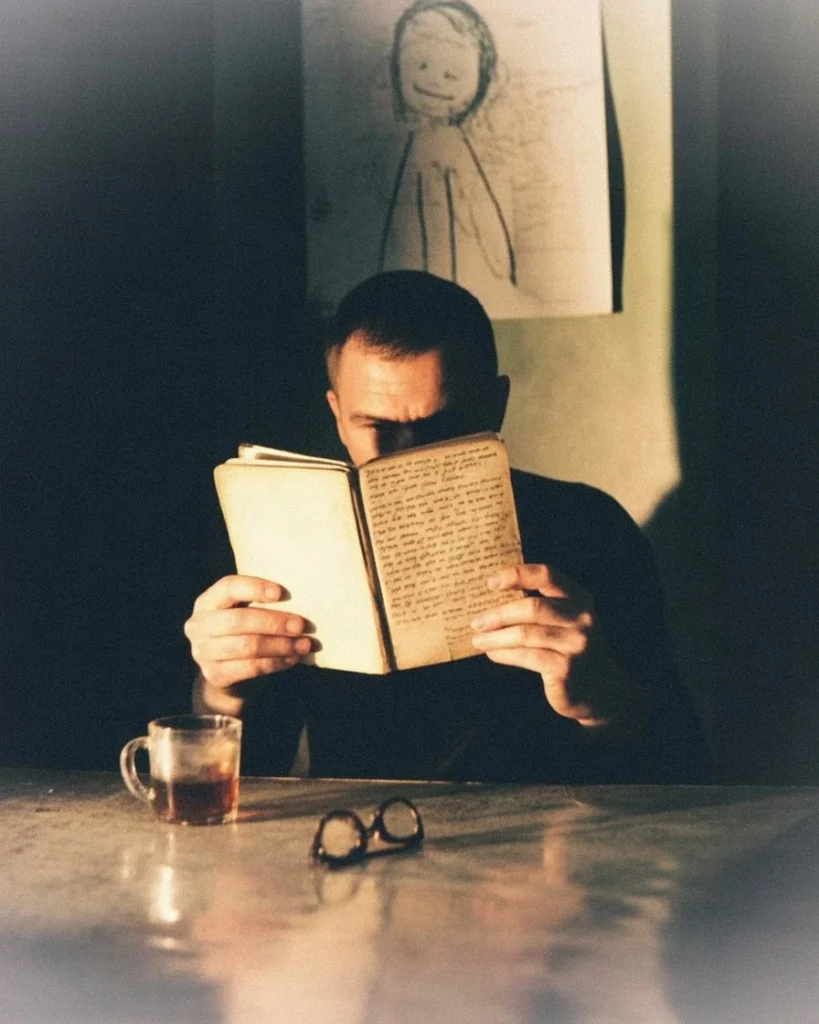
Then
The journal is in my handwriting. But the person who wrote it — I don’t know him. Why does nostalgia hurt for a stranger who shares your face?
Another exam tomorrow. Can’t wait till this semester ends.
That’s him. Sitting somewhere I’d trade years to return to, counting down to somewhere else.
He got what he wanted. The semester ended. Then another. Then all of them. He graduated into what he called real life, and real life arrived like a guest who never leaves and never quite fits.
Now I read his complaints the way you read a letter from someone who died young. With grief. With the particular cruelty of knowing what they didn’t, and still no answer for why does nostalgia hurt more than the original thing ever did.
The Boy with the Journal
My son found me reading it.
“What is that, Abba?”
“Old writing. From university.”
He sat beside me on the bed, uninvited, the way children do. He looked at the pages without being able to read them.
“Were you happy there?”
I held the question longer than a father should.
“I didn’t know.”
“Did you like it?”
“I thought I didn’t.”
“But you did?”
“I think so. Now.”
He looked at the page again. Looked back at me.
“So you were happy and you didn’t know?”
“Yes.”
“That seems bad.”
He got up and left. Back to whatever he was doing. He said the thing and walked away from it, the way children do before they learn to cushion everything.
I read every page of the journal that evening. Three hundred and forty-seven days of his life, the one I was living then without knowing I was living it.
Professor assigned three papers. This is torture.
Cafeteria food is inedible. Counting days till graduation.
Can’t wait to be done with this place.
Page after page. He was so eager to leave.
What he didn’t write: the table by the window in the cafeteria, the one we sat at every Thursday. A friend’s laugh that was too loud for indoors. The chai in small paper cups, always either too hot or already cold. How we’d sit there for two hours solving everything wrong with the world, and then walk back to our rooms, and do it again the following Thursday.
He didn’t write any of that.
He wrote: cafeteria food is inedible.
That table by the window — I could find it with my eyes closed. The grain of it. The particular wobble in one leg that you’d compensate for without thinking. The afternoon light that came in at a low angle in October and made everything look like it was being filmed.
He sat at that table three hundred Thursdays and never mentioned it once.
The Ache of the Dungeon
The apartment we shared in the third year had one window that faced a concrete wall. In winter, condensation ran down the inside of the glass and pooled on the sill. There was a smell we never identified. We had an understanding with the mold in the corner: it stayed there, we stayed here.
We called it the dungeon from the first week.
A friend called me last month. We hadn’t spoken in a while. After the first few minutes of everything catching up, he said:
“Remember the dungeon?”
“The smell.”
“What was that smell?”
“I never knew.”
“I’ve thought about that smell more times than I can count.” A pause. “I miss it. I’ve been trying to work out why does nostalgia hurt like this — for a smell, of all things. Which is insane.”
“I know.”
“We complained about that place every single day.”
“Every day.”
“And now —”
“And now.”
We stayed on the line without talking for a moment. Not an uncomfortable silence. The kind that means both people are in the same place.
“Those were good days,” he said finally.
“Were they though?” I asked. “Or do they just seem that way now?”
He thought about it.
“Does it matter?”
I didn’t have an answer.
“The building’s gone,” he said. “Demolished. I passed by last year. There’s a pharmacy there now.”
I held the phone.
The dungeon. The mold in its corner. The window with the condensation. The smell we never solved.
A pharmacy.
I’ve been returning to that place in my mind for years. Sitting in it when I’m sitting somewhere else. And it had already been nothing. Already air. I’ve been getting homesick for a building with no walls.
What She Knows
My wife comes home and drops her bag by the door.
Not hangs it. Drops it.
Then she stands in the kitchen looking at the kettle.
“How was it?”
“Same.”
She makes tea. Sits down. Doesn’t drink it.
“I need to leave that job.”
I didn’t say anything.
“The hours. The pressure. Every single day I think — I can’t do this anymore.”
“I know.”
She looked at me.
“You keep saying that.”
“Because I remember.”
“Remember what?”
“Counting days. From that first job. From the old apartment. The dungeon — you remember how we talked about it?”
“The smell.”
“We complained about it every single day. The AC. The mold. We said we couldn’t wait to leave.”
She wrapped both hands around the cup. Still too hot to drink.
“That’s different.”
“Is it?”
A long pause.
“I told my sister about that apartment last month,” she said finally. “We laughed for ten minutes.”
“Right.”
She looked at her tea.
“That doesn’t mean this job is worth staying in.”
“No. It doesn’t.”
She drank the tea. It had gone to the right temperature by then without either of us noticing. I didn’t say the rest: that someday she’d understand why does nostalgia hurt even for the hours she was counting down.
What He Said
My father had a habit of going quiet in the middle of dinner.
Not upset quiet. Just elsewhere quiet. His fork still, something happening behind his eyes that he didn’t share.
Then he’d come back.
“Beta.”
“Hmm.”
“You’re already somewhere else.”
I’d look up. “What?”
“Right now. Sitting here. You’re already thinking about after dinner. Or tomorrow. Or next week. You’re not here.”
“I’m just thinking about —”
“I know.” He’d go back to his food. “I did the same thing.”
That’s all he’d say. He never explained it further or told me what to do about it. Just said: I know. I did the same thing. And went back to eating.
He’s gone now. Both of them are. And what I remember is the table. The half-eaten plates. The way he held his fork — wrong, technically, by any instruction, but completely his. The way he said beta when he meant something he couldn’t quite say directly.
I was always, my whole life, already somewhere else — being present was something that happened to other people, in other rooms.
The Photograph
There’s a photograph from the third year — that 2000s nostalgia aesthetic, overexposed at the edges, everyone slightly too close.
Someone took it without asking — twelve of us crammed around a table meant for eight, paper cups everywhere, books shoved aside. Someone mid-laugh. Someone mid-argument. Someone looking directly at the camera with pure irritation.
I found my own face in it last week.
He looks exhausted. The particular exhaustion of someone with too much to do, who is counting time, who wants to be finished. His jaw is tight. He’s leaning slightly forward. Even in a photograph, he’s already heading somewhere else.
And around him: eleven people. Mid-laugh. Mid-argument. Mid-everything.
He didn’t know those people would scatter. Didn’t know that laugh — the one from a friend at his right, mouth open, completely unguarded — would become rare, then absent, then something he’d reconstruct from memory without being sure he had it right.
He just wanted to finish.
I want to tell him. I’ve spent years composing the thing I’d say, and also asking why does nostalgia hurt this way — aimed at a face you used to be.
But then what.
What does he do with that? Walk around the cafeteria thinking someday I’ll miss this while he’s eating food he still finds inedible? Watch himself have the Thursday conversations while he’s trying to have them? He was already watching himself — that was the whole problem. He was already standing slightly outside his own life, waiting for it to improve.
Telling him wouldn’t change the watching. Just the direction.
What He Doesn’t Know Yet
My son came back that evening with a different question.
We were washing dishes. He washes, I dry. Our arrangement.
“Abba.”
“Hmm.”
“Do you ever wish you didn’t know what you know now?”
I put the plate down.
“What do you mean?”
“Like — if you went back to university. Would you want to know that you’d miss it later? Or just live it not knowing?”
I thought about it.
“I don’t know.”
“Because if you knew,” he said, still washing, not looking at me, “you’d just be sad the whole time. Already missing it while you’re still there.”
The water kept running.
“That’s possible,” I said.
“So maybe not knowing is better.”
“Maybe.”
He handed me a cup.
“But you’d still want to go back?”
“Yes.”
“Even though you’d just complain again?”
I dried the cup. Set it on the rack.
“Probably.”
“That’s weird, Abba.”
“I know.”
He handed me another plate. We finished the dishes without talking. Why does nostalgia hurt is not a question you can ask while you’re still inside the thing. He dried his hands and left.
I stood at the sink for a while after.
The water was off. The kitchen was quiet. Outside, the sound of the street — someone’s engine, then nothing.
The Complaining
Last Tuesday, my son came home complaining.
Homework. A teacher. Something unfair at lunch. He talked through all of it in a single sustained run, the way he does when he needs the words to go somewhere before he can be still.
He dropped his bag. Sat at the table. Pulled out his notebook. Still talking while he opened it.
“I just want it to be summer vacation.”
“I know.”
“Everything would be better.”
“Maybe.”
He looked up.
“You’re not going to tell me to appreciate school?”
“No.”
“Why not?”
I put water on.
“Because it won’t help.”
He watched me.
“Did someone tell you to appreciate university while you were complaining?”
“Probably.”
“Did it help?”
“No.”
He looked back at his notebook. After a while: “But you still miss it.”
“Yes.”
“Even though you complained.”
“Yes.”
He wrote something in the notebook. I couldn’t see what. Maybe why does nostalgia hurt. Maybe something simpler.
I made tea. Put a cup next to him without saying anything.
He didn’t look up.
The tea went cold.
He didn’t drink it.
What the Photograph Doesn’t Show
My wife found the photograph on the table where I’d left it.
She looked at it for a long time. Longer than I expected.
“You looked miserable.”
“I was.”
“And also not.”
“And also not.”
She pointed at someone mid-laugh in the background.
“Who is that?”
“A friend. We’ve lost touch.”
“Did you know you’d lose touch?”
“No.”
She handed it back.
“I think that might be the whole thing,” she said.
“What is?”
“You can’t hold something and know you’re losing it at the same time.” She shrugged. “It doesn’t work like that.”
She went back to what she was doing.
I stood there with the photograph.
Twelve people. One table. The light coming in at a low angle, that October light — the kind that shows up in quotes about precious moments and means nothing until the moment is already gone. Someone mid-laugh, already fading.
What Still Hurts Right Now
My son is asleep. I can hear him through the door — he lives in the moment the way his breathing does, without effort or awareness.
Earlier, just before I turned off his light, he asked: “Abba, do you think I’ll miss being a kid?”
“Yes.”
“Even the hard parts?”
“Especially those.”
He thought about it. His face in the dark, still and serious.
“That’s kind of unfair.”
“I know.”
“Is there anything you can do about it?”
I sat on the edge of his bed, with nothing to offer him about how to be present with something you’re already losing.
“I don’t know,” I said.
“Oh.”
He was quiet for a moment.
“Abba?”
“Hmm.”
“Do you think you’re missing something right now — like, right this second — and you don’t know it?”
The window was open a little. Somewhere outside: an engine, a voice, then nothing.
“Yes,” I said.
“What is it?”
“That’s the thing. I don’t know.”
He pulled the blanket up.
“That’s scary,” he said.
“Yes.”
His breathing slowed. The room settled.
I stayed a few more minutes. The light from the hallway came under the door. In the other room, my wife moving around, the ordinary sounds of a house at night.
The window let in a little air.
I don’t know what I’m missing, and I’ve stopped asking why does nostalgia hurt with any expectation of an answer. Right now. This moment. Something is here that I’m already slightly elsewhere from — being present meaning staying in the room while the room is still the room. Maybe this — the light under the door, the sound of her in the next room, this particular silence. Maybe something I’m not even noticing. The grain of the wall. The way the house smells at this hour. The sound of him breathing.
My son asked if there’s anything you can do about it, how to be present in the moment without already mourning it.
I said I don’t know.
Maybe that was the wrong answer. Maybe why does nostalgia hurt is another version of the same question. Maybe the right answer is also: I don’t know.
Maybe not.