
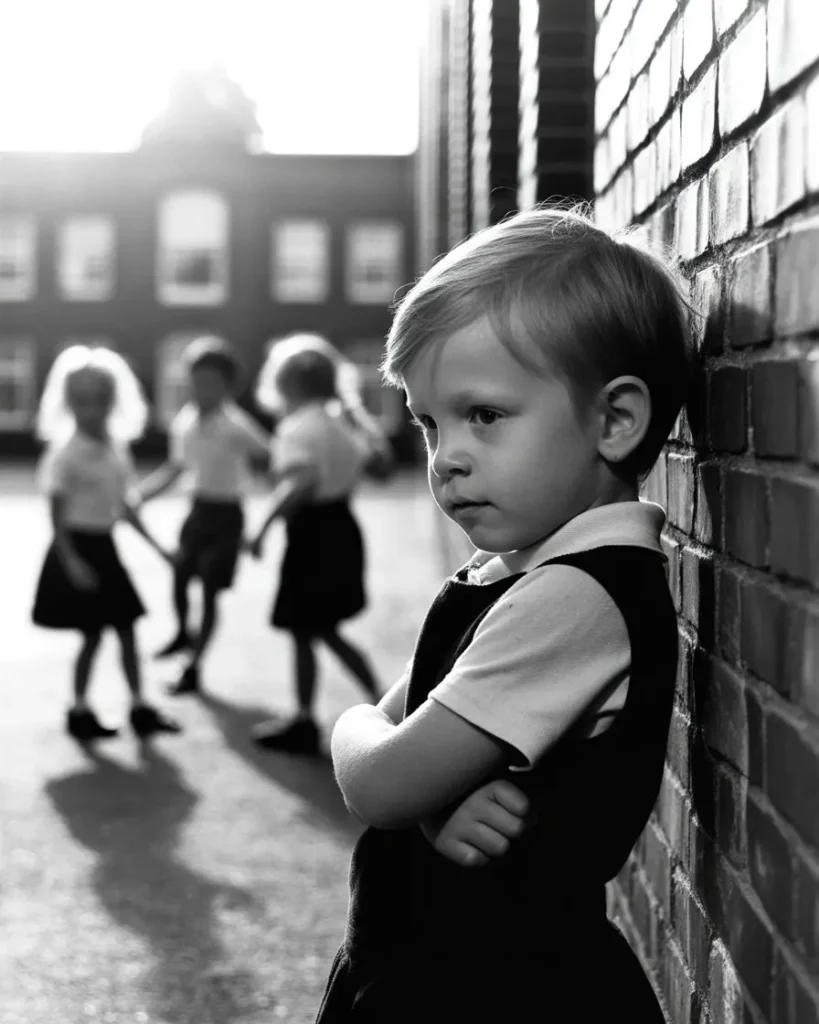
The Wall
You remember your childhood wrong.
Not the years. Not the house. The feeling. You remember it warmer than it was.
The kid who came home crying — that wasn’t just him. That was you. You stood at that same wall. You watched the others play from the same distance. You crossed your arms the same way, like you chose to be there. Like the wall was fine.
You forgot this.
You needed to forget it, so you did.
If you’ve ever asked yourself why don’t I remember my childhood the way others seem to — golden, easy, full of light — maybe the answer isn’t that your childhood was worse. Maybe it’s that you remember it more honestly than you think.
Nobody Chose You
There was a year — you know which one — when something shifted in the group. A fight between two of them, nothing to do with you, but suddenly you were eating alone. You didn’t understand why. You counted the days. You took longer routes home so you wouldn’t have to walk past anyone.
You forgot that year.
In its place you put: summer. Friends everywhere. Running until dark.
Both are true. You kept one.
This is what childhood memories do. They don’t disappear — they get sorted. The ones that hurt go into a drawer you stop opening. The ones with light stay on the shelf where you can see them every day.
The Long Afternoon
Sunday. Three o’clock. The house is quiet.
You have nothing to do. Everyone around you seems to have somewhere to be and you don’t. The hours don’t move. You lie on the bed and stare at the ceiling and feel something you can’t name — not sad, not bored exactly, just hollow. Waiting for life to start doing something.
You forgot those Sundays too.
Now you tell children: enjoy it while it lasts. You mean it. You believe it. You’ve been saying it so long you think it’s a memory.
It isn’t. It’s an edit.
This is why nostalgia hurts sometimes — not because the past was better, but because the version you built in memory never actually existed. You’re grieving a place that wasn’t real.
What the Dark Felt Like
The bedroom at night. Shapes on the wall that weren’t shapes. You pulled the blanket up. You tried to breathe quietly. You listened for something without knowing what you were listening for.
Nobody explained the adults. Their silences had weight you could feel but couldn’t measure. Dinner was sometimes too quiet. One of them would leave the room as the other entered. You moved through those days with something tight in your chest that you never gave a name to.
Many of the signs of childhood trauma aren’t dramatic. They’re quiet. A tightness. An alertness that never fully turns off. A childhood memory you keep almost reaching for — and then don’t.
You gave it no name so it would disappear.
It disappeared.
Is It Normal
People ask: is it normal not to remember your childhood clearly?
The mind keeps what you can use. Discards what would slow you down. A child moving toward adulthood doesn’t need the memory of lying awake scared — they need to believe they were okay. So the scared nights get filed. The golden afternoons stay.
Why don’t I remember my childhood isn’t always a question about trauma. Sometimes it’s just a question about survival. You built a self. You used what you needed. You left the rest.
The problem isn’t that you forgot.
The problem is when you hand that edited version to the child in front of you and call it truth.
The Child in Front of You
He can’t sleep.
He asks: will I be okay?
You almost say yes, automatically, the way you’ve been saying it — meaning nothing, filling air.
Instead you sit there. The night light is on. His eyes are open, waiting.
You think about the wall. The long way home. The Sunday ceiling. The tight chest with no name.
“I felt the same thing,” you say.
He looks at you like you said something impossible.
“You?”
“Me.”
He moves over slightly. Makes space without asking if you want it.
You lie down next to him. The bed is too small. Neither of you mentions this.
What your childhood memories say about you isn’t what you think. They don’t reveal what happened. They reveal what you needed to believe happened. The favorite childhood memory you carry everywhere — the one that feels warm and complete — is the one you built most carefully.
The others are still there.
The Photograph
It falls out of a folder you weren’t looking through.
You’re nine. Maybe ten. Standing in a courtyard. Arms crossed. Looking at something to the left of the camera that no longer exists.
You’re not smiling.
You don’t remember that day. You don’t know what you were looking at. Whatever it was — a rejection, a loneliness, an afternoon that wouldn’t end — it’s gone. No vivid memory attached to it. Just the posture. The crossed arms.
You’ve seen that posture recently.
Why can’t I remember my childhood the way this photograph remembers it? Because the photograph didn’t need to survive. You did.
What You Did With It
You made it golden because you had to.
You were going to become an adult in a difficult world and you needed somewhere safe to return to in your mind. A place where things were simple, where someone else handled the fear. So you built that place from the real one. Kept the light, removed the shadow.
This isn’t weakness. It’s what children do.
Childhood nostalgia isn’t memory — it’s architecture. You built something liveable from something complicated, and you’ve been living in it ever since.
Why don’t I remember my childhood accurately? Because accuracy wasn’t the point. Survival was.
But the child in the photograph is still there. Arms crossed. Looking at something out of frame.
He never left.
You just stopped looking at him.
And now there’s another child. In the next room. Lying in the dark. Counting the hours until morning.
He’s building the same childhood memory right now — deciding what to keep, what to file away, what to turn golden by the time he’s your age.
You can’t stop that.
You can only sit next to him in the dark.
Not explain it.
Not fix it.
Just be the one person who doesn’t pretend it isn’t happening.
The night light hums.
Outside, something passes.
Goes quiet.
He falls asleep before you do.
You lie there in the small bed, in the orange light, next to the child who will one day ask himself why don’t I remember my childhood the way it really was —
and you let him.