
Anonymous
The Room
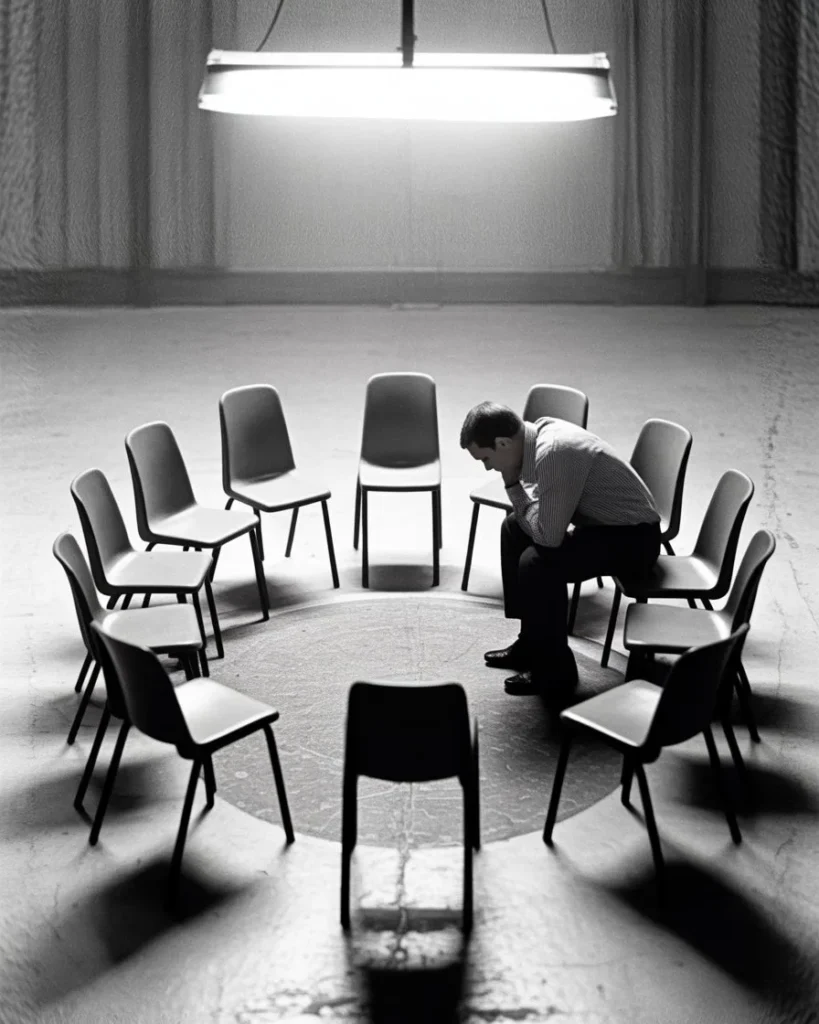
Twelve plastic chairs. Fluorescent light that flickers once, then holds.
A man walks in. Sits down without looking at anyone. Puts his hands on his knees. Stares at the floor.
Nobody asks his name. That’s the whole point.
The first time someone walks into love addiction anonymous, they usually stand at the door for a full minute before sitting down. Not because they’re unsure of the address. Because sitting down means admitting the address is correct.
This is not glamorous. Not cinematic. Just a room full of people who loved the wrong thing too hard for too long and finally ran out of ways to pretend otherwise.
What Brought You Here
Nobody comes to a room like this because things were going well.
The man with his hands on his knees — he called her seventeen times in one night. Not because he’s dangerous. Because the silence after she stopped responding felt like something was dying inside his chest. Because the love addiction symptoms had been building for years and he’d mistaken every one of them for passion.
A woman in the corner came because her doctor asked her: do you feel physical pain when he doesn’t contact you?
She said yes.
Her doctor wrote something down.
That was six months ago. She’s been in this room every Thursday since.
Love addiction symptoms are not metaphors. The chest tightening. The inability to eat. The checking of the phone every four minutes. The way a single message can flip an entire nervous system from anguish to relief in under a second. This is biochemistry. This is real.
The Cycle Nobody Admits
Here is what love addiction treatment tries to explain, and what the person in the grip of it cannot fully hear:
The relationship was never really about the other person.
This sounds wrong. It feels wrong. But sit with it.
The other person was a delivery mechanism. A way of getting a specific feeling — not love exactly, but the relief of almost-having. The brief warmth after cold. The moment of attention after hours of absence.
That cycle is what love addiction does. It takes the most ordinary human need — to be seen, to matter — and warps it into something that can only be satisfied by the one person most guaranteed not to satisfy it.
The anxious one finds the avoidant one. Every time.
Not bad luck. Not fate. The nervous system recognized the shape of the wound and moved toward it before the mind could intervene.
What is love addiction if not this: a person trying to solve an old equation with a new variable that will never balance it.
The Story Everyone Tells
In the room, people talk.
Not in dramatic monologues. In fragments. Half-sentences that trail off because everyone already knows the ending.
I knew she wasn’t good for me but—
Every time I tried to leave, he’d—
I kept thinking if I could just be enough—
The love addict’s story has only one plot. The details change. The core never does. Someone withholds. Someone chases. Someone gives everything trying to earn what is not coming. Someone confuses the hunger itself for love.
There are love addiction movies that romanticize this. Songs about addiction and love that make the cycle sound like poetry. And it is, in a way — the same way a fever is beautiful before it kills you.
In the room, nobody romanticizes it. In the room, it just sounds like exhaustion.
What Facing It Costs
Facing love addiction is not a single moment.
It’s not a breakdown in a parking lot, or a conversation that finally goes too far, or a night so bad that something permanently shifts. Those things happen. But they are not the facing.
The facing is what comes after. The Tuesday morning when there’s no chaos to manage and the silence feels unbearable. The realization that the relationship, as destructive as it was, had been organizing an entire internal life. Had been providing, in its terrible way, a reason to feel things. A direction for all that need to go.
Without it: emptiness. And the emptiness is not peaceful. It’s loud.
This is what love addiction treatment cannot fully prepare you for. The withdrawal is real. The craving doesn’t obey reason. Every love addiction book says: give it time. Every person in early recovery thinks: you don’t understand how different my situation is.
They all think that. That’s also part of it.
The One Nobody Talks About
There is a person in every room like this who says almost nothing.
Not because they’re not suffering. Because they’ve been suffering longer than anyone, and somewhere along the way the suffering became simply the texture of their life. They stopped calling it a problem. They stopped calling it anything. They just lived inside it.
This person had parents who loved each other this way. Chaotically. Intensely. With long silences and sudden warmth and a quality of attention that was either everything or nothing, never steady. Love and addiction were the same word in that house. Were always the same word.
They learned early: this is what love is. This is its shape. This is how it moves.
They’ve been looking for that shape in every room ever since.
People who grew up inside that shape don’t find love addiction anonymous through a therapist’s referral or a crisis hotline. They find it because one day they hear someone across a plastic table describe their childhood in exact detail, and they realize the room has been waiting for them for years.
What Steady Feels Like
A woman in the room says: I met someone kind. I left after three weeks. I told myself there was no spark.
Everyone in the room nods. Not with sympathy. With recognition.
The cure for love addiction — if there is one — is not falling in love correctly. It is learning to tolerate a feeling that the nervous system keeps misreading as boredom.
Steadiness. Consistency. Someone who says they’ll call and then calls.
After years of the cycle, this registers as flatness. As absence. As wrong.
The love addict doesn’t need more passion. The love addict needs to sit in a quiet room with someone kind and not leave. To resist the pull toward familiar fire. To let the flatness gradually, over months, reveal itself as something else entirely.
Not flatness. Ground.
Something to stand on that doesn’t move.
The Room, Again
The fluorescent light flickers once more. Holds.
The man with his hands on his knees finally looks up. Says nothing. But he’s still in the chair.
That’s all it is, some weeks. Just staying in the chair.
Outside, the city moves. People walk into coffee shops. Catch someone’s eye across the room. Feel their chest do that old familiar thing.
Some of them will walk toward it.
Some of them, on a Thursday, will find themselves outside a room with twelve plastic chairs and a flickering light. Will stand at the door for a full minute. Will finally sit down.
Love addiction anonymous doesn’t promise anything. No cure written on the wall. No timeline on the whiteboard. Just the chairs, the light, and the slow, unglamorous work of people who finally stopped pretending the fire wasn’t burning them.
I don’t know if that’s enough.
Maybe it has to be.